Telcordia Sr 332 Handbook To Higher
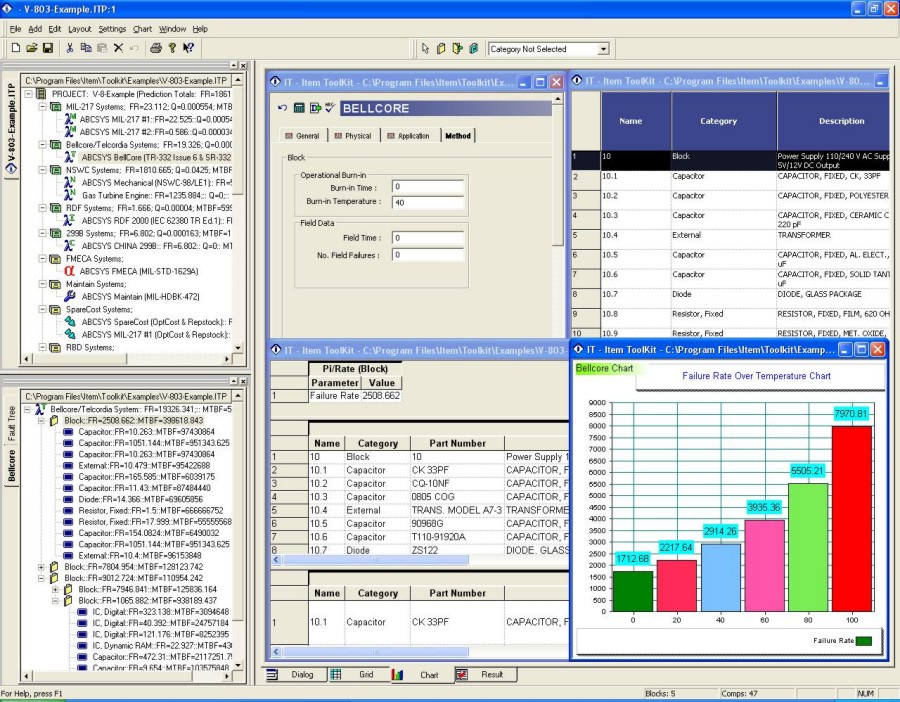
Retrouvez toutes les discothque Marseille et se retrouver dans les plus grandes soires en discothque Marseille. Bellcore Telcordia Standard The Bellcore standard predicts the reliability of electronic equipment based on the Bellcore Telcordia standards TR332 Issue 6 and SR. Reliability engineering Wikipedia. Reliability engineering is a sub discipline of systems engineering that emphasizes dependability in the lifecycle management of a product. LargeProductImages/L0555434-01.jpg' alt='Telcordia Sr 332 Handbook To Higher' title='Telcordia Sr 332 Handbook To Higher' /> Dependability, or reliability, describes the ability of a system or component to function under stated conditions for a specified period of time. Reliability is closely related to availability, which is typically described as the ability of a component or system to function at a specified moment or interval of time. Reliability is theoretically defined as the probability of success Reliability1Probability of Failure displaystyle textReliability1 textProbability of Failure as the frequency of failures or in terms of availability, as a probability derived from reliability, testability and maintainability. Testability, maintainability and maintenance are often defined as a part of reliability engineering in Reliability Programs. Reliability plays a key role in the cost effectiveness of systems. Reliability engineering deals with the estimation, prevention and management of high levels of lifetime engineering uncertainty and risks of failure. Telcordia Sr 332 Handbook To Higher Conscience' title='Telcordia Sr 332 Handbook To Higher Conscience' />
 Although stochastic parameters define and affect reliability, reliability is not solely achieved by mathematics and statistics. You cannot really find a root cause needed to effectively prevent failures by only looking at statistics. Nearly all teaching and literature on the subject emphasize these aspects, and ignore the reality that the ranges of uncertainty involved largely invalidate quantitative methods for prediction and measurement. Reliability engineering relates closely to safety engineering and to system safety, in that they use common methods for their analysis and may require input from each other. Reliability engineering focuses on costs of failure caused by system downtime, cost of spares, repair equipment, personnel, and cost of warranty claims. Safety engineering normally focuses more on preserving life and nature than on cost, and therefore deals only with particularly dangerous system failure modes. High reliability safety factor levels also result from good engineering and from attention to detail, and almost never from only reactive failure management using reliability accounting and statistics. HistoryeditThe word reliability can be traced back to 1. Samuel Taylor Coleridge. Before World War II the term was linked mostly to repeatability a test in any type of science was considered reliable if the same results would be obtained repeatedly. In the 1. 92. 0s product improvement through the use of statistical process control was promoted by Dr. Walter A. Shewhart at Bell Labs,7 around the time that Waloddi Weibull was working on statistical models for fatigue. The development of reliability engineering was here on a parallel path with quality. The modern use of the word reliability was defined by the U. S. military in the 1. In World War II, many reliability issues were due to the inherent unreliability of electronic equipment available at the time, and to fatigue issues. In 1. 94. 5, M. A. Miner published the seminal paper titled Cumulative Damage in Fatigue in an ASME journal. A main application for reliability engineering in the military was for the vacuum tube as used in radar systems and other electronics, for which reliability proved to be very problematic and costly. The IEEE formed the Reliability Society in 1. In 1. 95. 0, the United States Department of Defense formed group called the Advisory Group on the Reliability of Electronic Equipment AGREE to investigate reliability methods for military equipment. This group recommended the following 3 main ways of working Improve component reliability Establish quality and reliability requirements for suppliers Collect field data and find root causes of failures. In the 1. 96. 0s more emphasis was given to reliability testing on component and system level. Reliability engineering is a subdiscipline of systems engineering that emphasizes dependability in the lifecycle management of a product. Dependability, or. This article illustrates how reliability prediction methods for electronic products can improve the competitiveness of a product. The MIL217, BellcoreTelcordia and. OLB.jpg' alt='Telcordia Sr 332 Handbook To Higher' title='Telcordia Sr 332 Handbook To Higher' />The famous military standard 7. Around this period also the much used and also much debated military handbook 2. RCA Radio Corporation of America and was used for the prediction of failure rates of components. The emphasis on component reliability and empirical research e. Mil Std 2. 17 alone slowly decreases. More pragmatic approaches, as used in the consumer industries, are being used. In the 1. 98. 0s, televisions were increasingly made up of solid state semiconductors. Keygen Windows 7 Ultimate 32 Bit'>Keygen Windows 7 Ultimate 32 Bit. Automobiles rapidly increased their use of semiconductors with a variety of microcomputers under the hood and in the dash. Large air conditioning systems developed electronic controllers, as had microwave ovens and a variety of other appliances. Communications systems began to adopt electronics to replace older mechanical switching systems. Bellcore issued the first consumer prediction methodology for telecommunications, and SAE developed a similar document SAE8. The nature of predictions evolved during the decade, and it became apparent that die complexity wasnt the only factor that determined failure rates for Integrated Circuits ICs. Kam Wong published a paper questioning the bathtub curve9see also reliability centered maintenance. During this decade, the failure rate of many components dropped by a factor of 1. Software became important to the reliability of systems. By the 1. 99. 0s, the pace of IC development was picking up. Wider use of stand alone microcomputers was common, and the PC market helped keep IC densities following Moores law and doubling about every 1. Reliability engineering now was more changing towards understanding the physics of failure. Failure rates for components kept on dropping, but system level issues became more prominent. Systems thinking became more and more important. For software, the CCM model Capability Maturity Model was developed, which gave a more qualitative approach to reliability. Sibelius 7 Utorrent. ISO 9. 00. 0 added reliability measures as part of the design and development portion of Certification. The expansion of the World Wide Web created new challenges of security and trust. The older problem of too little reliability information available had now been replaced by too much information of questionable value. Consumer reliability problems could now have data and be discussed online in real time. New technologies such as micro electromechanical systems MEMS, handheld GPS, and hand held devices that combined cell phones and computers all represent challenges to maintain reliability. Product development time continued to shorten through this decade and what had been done in three years was being done in 1. This meant that reliability tools and tasks must be more closely tied to the development process itself. In many ways, reliability became part of everyday life and consumer expectations. OvervieweditObjectiveeditThe objectives of reliability engineering, in decreasing order of priority, are 1. To apply engineering knowledge and specialist techniques to prevent or to reduce the likelihood or frequency of failures. To identify and correct the causes of failures that do occur despite the efforts to prevent them. To determine ways of coping with failures that do occur, if their causes have not been corrected. To apply methods for estimating the likely reliability of new designs, and for analysing reliability data. The reason for the priority emphasis is that it is by far the most effective way of working, in terms of minimizing costs and generating reliable products.